
Separation Anxiety Camera Guide: What Your Dog Does When You're Gone
Lopaw · · 13 min read
A camera shows what actually happens after the door closes. Setup in ten minutes, the eight stress signs to watch, and how to find your dog's threshold.
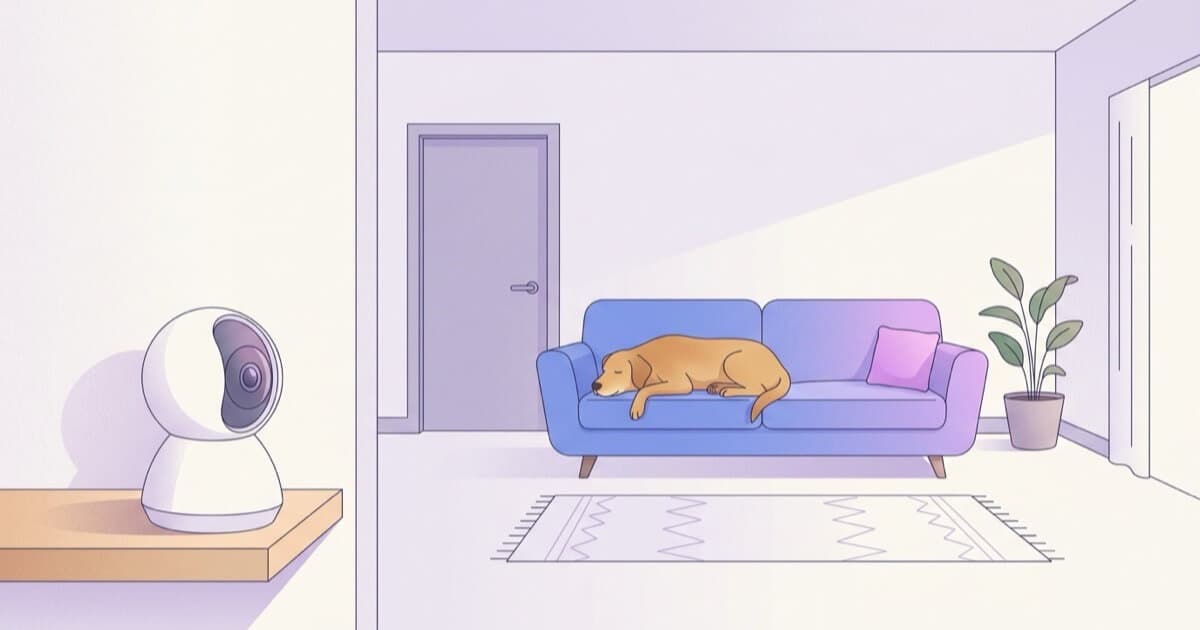
Filming a single absence is the clearest way to see what your dog does alone and whether it looks like separation anxiety. Neighbors hear the loud part, but quiet signs often tell you more (here is what your neighbors hear, and what to log). Ten minutes of setup with a phone you already own answers questions no amount of guessing will.
Key Takeaways
- Watch the first two minutes closely. That cut-off is a practical rule of thumb and does not come from a study.
- A silent dog can still be stressed. Pacing, drooling and refusing food happen quietly.
- One of the most telling things in the footage is whether your dog eats. Highly anxious dogs usually won't eat when their guardians are gone (ASPCA).
- The footage gives you a number: the point at which your dog stops being settled. Every plan starts from that number.
- Log four things per session and you can see progress. Log nothing and you cannot.
Why the recording is the whole diagnosis
Everything you know about your dog alone right now came from evidence after the fact. A chewed door frame, a puddle, a note from a neighbor, a barking-detection alert on your phone. All of that tells you something happened. None of it tells you when it started, how long it lasted, or what your dog's body was doing.
That matters because the treatments diverge, and because separation anxiety is a specific condition with its own treatment, and many dogs that dislike being left do not have it. A bored dog that starts chewing after 40 minutes needs a different intervention from a panicking dog that starts pacing before you reach the elevator. The two produce similar wreckage and require nearly opposite responses, so you have to see the difference with your own eyes. It helps to know the six reasons dogs react to being left, and how to tell them apart.
What you need
You almost certainly already have it.
| Option | Cost | Good for | Watch out for |
|---|---|---|---|
| Your current phone, propped up, recording locally | Free | A one-off diagnostic absence | You have no phone with you while you are out |
| An old phone plus a free camera app | Free | Repeat sessions, live view | Needs charging, needs wifi for live view |
| A laptop webcam and a video call to yourself | Free | Same-day answer | Screen sleep settings, and it ties up the laptop |
| A dedicated pet or home camera | Low for basic models | Ongoing training, two-way audio, treat tossing on some models | Some record only short clips, and some keep video only on a paid plan. Two-way audio is a trap in the first weeks. See below |
This table deliberately leaves out brand recommendations. Any camera that records continuously with sound is sufficient for this, and footage resolution matters far less than how you read it. If you train with an app, keep the camera too. Separation anxiety training apps can time an absence, but only footage shows you how your dog coped with it.
About two-way audio. Talking to your dog through a camera while you are out is tempting and unhelpful early on. It confirms that you exist somewhere else, which for a dog in distress tends to restart the search. Leave the speaker off until your dog can already do calm absences.
How to set it up in ten minutes
- Pick the frame that includes the exit. The door you leave through, plus your dog's usual resting spot. If you can only have one, choose the door. Damage in separation problems is usually aimed at exit points (McCrave 1991, cited by Palestrini et al., 2010).
- Get it high and stable. A shelf, a stack of books, a windowsill. Higher is better, because a floor-level camera loses your dog behind furniture at exactly the wrong moment.
- Leave the sound on. Whining tells you a lot, and it is easy to miss from the hallway.
- Check the light. If you leave before dawn or after dusk, leave one lamp on in frame. Infrared footage is fine for movement but useless for reading a face.
- Do a five-second test. Record, walk out, walk back in, watch it. Fix the angle now, before a 40-minute absence shows you the problem.
- Put out food. A stuffed Kong, a lick mat, or a portion of your dog's normal meal, in frame. Here the food is a measurement instrument.
- Leave normally. Do not stage a calm departure or a long goodbye. The point is to record your ordinary routine.
- Note the exact time you close the door. Everything is measured from that second.
Record a single absence that is roughly as long as a normal short trip. Twenty to 30 minutes is plenty. You do not need to leave your dog for hours to get an answer, and if the first two minutes are bad, you already have your answer and should come home.
The eight stress signs you can see on video
Watch the first two minutes at normal speed, twice. Then scan the rest at four times speed and slow down whenever the dog moves. Treat the two-minute mark as a rule of thumb rather than a research cut-off. In a video study of 23 dogs seen at two behavior clinics, most showed signs within 10 minutes of the owner leaving, and vocalizing began after 3.25 minutes on average (Palestrini et al., 2010).
1. Pacing on a fixed route
Look for the same loop, repeated: door, sofa, window, door. The ASPCA lists pacing along a fixed path as a sign of separation anxiety (ASPCA), and it can start soon after you leave.
2. Drool, or a wet patch
Check the floor by the door and the bedding first, since the mouth is often hard to see on camera. A wet chin, dark patches on fabric, or smears on the tiles by the exit all count. The ASPCA lists salivating among the signs of stress to watch for (ASPCA). Dogs cannot drool on purpose to protest, which is exactly why it is such a reliable sign.
3. Yawning and lip-licking out of context
A yawn from a dog that just woke up means nothing. A yawn from a dog standing tense at the door means a great deal. The same goes for a quick tongue flick across the nose when there is no food present. AVSAB lists lip licking, yawning and a tense body among stress-related behaviors in dogs (AVSAB, 2021). Count these in the first two minutes.
4. Ears back, tight body, whale eye
A stress posture reads as compressed: weight shifted back, tail low or tucked, ears pinned, mouth closed and tight rather than open and loose. "Whale eye" is the white crescent visible when the head stays still and the eyes track the door.
5. Whining, barking, howling
In a video study of 20 dogs with separation problems, 19 whined, 17 barked and 14 howled, and the authors link barking to arousal while suggesting whining and howling may reflect fear (Lund and Jørgensen, 1999). Two barks at a noise in the hallway followed by lying down is something else entirely.
6. Work at the exit
Scratching, digging at the threshold, chewing the frame, jumping at the handle, pulling at the carpet in front of the door. Damage concentrated at the exit means something different from damage spread around the apartment. The location is the signal.
7. Refusing food
Food is the most underrated line in the footage. A dog that ignores a stuffed Kong it would demolish in your presence is telling you it is over its threshold. The ASPCA notes that highly anxious dogs usually won't eat when their guardians are gone. That makes eating a useful dial for tracking progress across weeks.
8. Trembling, freezing, hiding
Easy to miss because there is nothing to hear. Wedged behind the toilet, motionless in a corner, or shaking on its bed: all of these are distress. The ASPCA lists trembling among its stress signs (ASPCA), and this is the pattern most often mistaken for "she's fine, she just sleeps".
Signs this is probably not separation anxiety
Read the footage honestly in both directions.
- Settles within a few minutes and stays settled. Some reaction to a departure is normal. A short protest that resolves into genuine sleep is a different problem from panic, and it usually needs a smaller intervention. More on why some dogs howl for ten minutes and then stop.
- Eats. Working through its Kong and then napping is what a relaxed dog does.
- Sleeps for most of the absence. Watch for real sleep: side-lying, loose limbs, changed breathing. Lying sternally with the head up and eyes open means your dog is still on duty.
- Damage is spread out and looks like fun. Trash raided, shoes carried to the sofa, cushion disemboweled in the middle of the room. Distress damage clusters at exits and windows (ASPCA).
- Reactions are triggered by outside events. Barking that starts when the elevator door opens or when a delivery arrives, and stops after, is alert barking. Turn the volume up and listen for the trigger before the bark.
How to find your dog's threshold from the footage
Threshold is the length of absence your dog can handle while staying genuinely settled. It is the number every plan is built on, and the recording gives it to you directly.
Step 1. Find the moment the door closes. Timestamp zero.
Step 2. Find the first genuine stress signal. Any of the eight above. Note the timestamp. Ignore a single ear flick or one glance at the door. You are looking for the first signal that persists or repeats.
Step 3. Subtract. The gap between the two is your dog's current threshold. If your dog started pacing at 00:35, your threshold is around 30 seconds.
Step 4. Sanity check it against the food. If the Kong is untouched at the end, your dog was over threshold for most of the absence, so start well below the first stress signal. If your dog ate normally and then relaxed, your threshold is longer than the first stress signal suggested and you can be a little more generous.
| What the recording shows | Your starting point |
|---|---|
| Stress signals before you reach the front gate | A few seconds. Start with the door, not with leaving |
| Settled for under a minute, then pacing or vocalizing | 20 to 40 seconds |
| Settled for several minutes, eats, then escalates | 2 to 5 minutes |
| Settled for 20 minutes, eats, sleeps, then wakes and reacts | 15 to 20 minutes, and check for a trigger at the wake-up point |
| Settled throughout, eats, sleeps | Longer than the absence you filmed. Film a longer one |
People find two things hard to accept here. Both are normal.
Thirty seconds is a legitimate starting point. Plenty of dogs begin there, and it reflects nothing about how well you have raised yours. Treat it as a baseline, because baselines exist to be moved.
General rules like "dogs can be left for an hour" do not set your number. They describe populations, while your dog's threshold is a measurement of your dog. The howls guide explains why a short protest and a real threshold are different numbers.
What to log, and why it is not optional
Four fields per session. That is the whole system.
| Field | Why it earns its place |
|---|---|
| Start time and duration | Without it you cannot tell a good session from a lucky one |
| Time to first stress signal | This is the number that should be growing. It is your actual progress metric |
| Intensity, 1 to 3 | Distinguishes "glanced at the door" from "scratched at the door". Ranking beats describing |
| Ate or did not eat | The cleanest binary you have, and the earliest thing to improve |
Progress in this protocol moves in fits and starts and rarely feels like progress from inside. Week three can look worse than week two. Without a log you interpret that as failure and stop. With a log you can see that the time-to-first-signal is still trending up across ten sessions even though last night was bad, which is the difference between finishing the program and abandoning it (see how long separation anxiety training usually takes).
When you have your number, the plan starts. Follow the week-by-week training plan for leaving your dog alone, which opens with three things to sort out before your first session.
FAQ
How long should the first recording be? Twenty to 30 minutes. If your dog is in visible distress in the first two minutes, come home. You already have what you needed and there is nothing to gain from more footage.
Do I need a special pet camera? No. A phone propped on a shelf recording locally answers the diagnostic question. A dedicated camera is convenient for repeat sessions because of the live view. The footage itself is no better, and some models keep video history only on a paid plan.
Should I talk to my dog through the camera? Not in the early weeks. Your voice from a device tells a distressed dog that you exist somewhere reachable, which tends to restart the searching. Save two-way audio for a dog that already does calm absences.
My dog is totally silent the whole time. Is it fine? Maybe, and maybe not. Check the floor for drool, check whether the food was eaten, and check whether your dog moved at all. Freezing and trembling are silent. Silence plus eating plus real sleep is a good sign. Silence plus an untouched Kong is not.
What if the footage looks bad and I feel awful? Ordinary reaction, and worth naming. Two things help. First, what you are seeing is a distress response, not misbehavior, and the ASPCA is explicit that punishing it makes it worse (ASPCA). Second, you now have a starting number, which is more than you had this morning.
How often should I film? Every training session in the first two weeks, if you can. After that, film once or twice a week plus any session that surprises you, and stop when your notes and the footage keep agreeing.
Last updated: