
How to Train a Dog to Be Home Alone: Week-by-Week Plan
Lopaw · · 17 min read
The graduated desensitization protocol written out step by step, from the prep work to week one, when to add time, and what to do when it goes backwards.
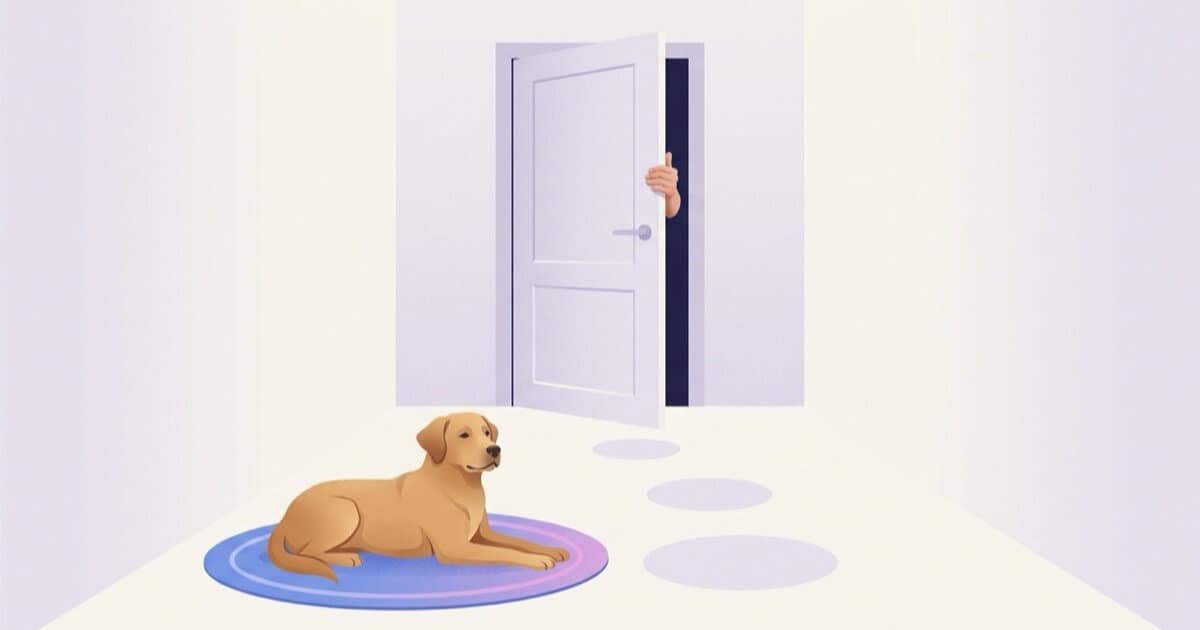
Graduated desensitization works by keeping every session below the point where your dog becomes distressed, then adding time in small increments once calm repetitions accumulate. This is the full protocol, written out step by step, including the prep work and the first two weeks before any real absence.
Key Takeaways
- Three things happen before session one: a vet check, a measured threshold, and cover for the hours you cannot yet leave your dog alone.
- Week one contains no leaving at all. It is keys, shoes and coat, and you skip it only if those cues produce no reaction.
- The rule for adding time is three calm repetitions at the current duration.
- Log four things per session. Without a log you cannot distinguish a regression from a failure.
- The ASPCA says most anxious responses "will occur within the first 40 minutes", and that a dog calm for 90 minutes "can probably handle four to eight hours" (ASPCA). Even then, the RSPCA and Dogs Trust advise no more than about four hours alone at a stretch.
Before you start: three non-negotiables
1. A vet check
Urinary tract infections, incontinence, diabetes, Cushing's disease and medication side effects all produce behavior that reads as separation distress (ASPCA). Pain can too. Training a dog through a medical problem does not work and costs months.
2. A measured threshold
Threshold is how long your dog stays genuinely settled after you leave, and every number in this plan is relative to it. You get it from a recording: note when the door closes, note the first stress signal that persists, subtract. How to film an absence and read the footage.
Do not estimate this. A guess that is 60 seconds too generous means every session for the next two weeks is above threshold, which is worse than doing nothing.
If your number turns out to be 20 seconds, that is a normal starting point, and the guide to short thresholds explains what the number means.
3. Cover for the hours you cannot do yet
This is the requirement people skip and the one that decides the timeline. The protocol only works if, outside of training sessions, your dog is not left alone at all (ASPCA).
For a dog with a 30-second threshold and an owner who works in an office, that is a real logistical problem, and it has real solutions:
| Option | Notes |
|---|---|
| Daycare | Best for dogs that enjoy other dogs. Check the facility's own handling policy |
| Dog walker or sitter, mid-day | Splits an eight-hour absence into two shorter ones, which helps even before training starts |
| Split schedule with a partner or housemate | Free, and usually the most sustainable for six to eight weeks |
| A neighbor, a friend, a relative | Underused. Many people will sit in your apartment with a laptop for two hours |
| Working from home, or a period of leave | Worth spending some of it on this if you have it |
| Bring the dog with you | Depends entirely on your circumstances, and worth asking about |
Plan at least six to eight weeks of this, and keep it going until your dog's threshold covers the absences you actually need. The ASPCA treats it as a precondition for the whole protocol, and arranging it in advance is much easier than improvising it in week two. For the full comparison of cover options, and how to plan a week, see the management guide.
The core principle: stay under threshold
Your dog's response to being left is a prediction. Right now the closing door predicts something bad. The protocol works by accumulating a large number of experiences where the door closes and nothing bad happens, until the prediction changes.
Two consequences follow:
A session above threshold does not count. It counts against you. If your dog panics, that session has added evidence to the prediction you are trying to change. This is why "she has to get used to it" fails. Repetition above threshold consolidates the response.
Small and frequent beats big and rare. Ten sessions of thirty seconds is worth much more than one session of five minutes, even though the total time is shorter. What you are counting is experiences.
This is also why punishment has no place here. AVSAB's position is that only reward-based methods should be used, and that documented effects of punishment include inhibited learning and increased fear-related and aggressive behavior (AVSAB, 2021). Beyond the welfare question, a suppressed signal is an unusable signal: if your dog stops vocalizing because of a collar rather than because it is calm, you have lost your only measurement.
Week 1: pre-departure cues
Goal: the keys, the shoes, the coat and the bag stop predicting anything.
Why this comes first: for some dogs the response starts before the door. The ASPCA notes that "some dogs begin to feel anxious while their guardians get ready to leave" (ASPCA). Nothing you do at the door will work while the run-up to it is still a reliable alarm.
Do not leave the house at all this week. If your dog has only just arrived, the rescue dog's first week alone covers the days before this plan starts.
Week 1 exercise: departure cues
- Sit down somewhere your dog can see you. Wait until it is settled and not watching you expectantly.
- Pick up your keys.
- Put them down again, immediately, without looking at your dog.
- Carry on doing something boring: read, make tea, put laundry away.
- Watch your dog out of the corner of your eye. What you want is nothing: no getting up, no ear shift, no following you.
- Repeat five to ten times in a session. Two or three sessions a day.
- When your dog has stopped reacting to the keys for two consecutive sessions, add the next cue: shoes. Then coat. Then bag. One at a time.
- Once each cue is boring separately, start chaining them: keys plus shoes. Then keys, shoes and coat. Then the whole sequence, ending with you sitting back down.
Week 1 success: cues get no reaction
Your dog does not get up when you pick up the keys, and does not get up when you put your coat on. If it still gets up on the tenth repetition, do more repetitions of that single cue rather than moving on.
Week 1 pitfalls
- Do not reward the calm with attention. Attention makes you interesting, and this exercise depends on you being boring. Just carry on.
- If your dog reacts to a cue you have not yet worked on, note it and add it to the list. Common ones people miss: the sound of a particular zip, the alarm being set, turning a light off, closing the bathroom door.
- Boring is the point. If this week feels pointless, it is working.
Week 2: the door
Goal: the front door opening and closing is a non-event, and stepping outside for a second or two is a non-event.
Week 2 exercise: the door
- Run one short cue sequence from week one so you are starting from a settled dog.
- Walk to the door. Touch the handle. Walk away. Repeat until your dog stops tracking you to the door.
- Open the door a few centimeters. Close it. Walk away. Repeat.
- Open the door fully. Close it. Walk away. Repeat.
- Open the door, step out, step back in immediately, close it behind you. This is a one-second absence, and for many dogs it is the first real repetition of the whole program.
- Repeat step 5 between five and ten times per session, two or three sessions a day.
- Extend to two seconds. Then three. Then five.
- Vary the interval between repetitions so your dog cannot predict the rhythm. Some back to back, some with a two-minute gap.
The ASPCA's version of this stage starts with out-of-sight stays of one to two seconds at an interior door before moving to the exit, which is worth borrowing if your dog cannot yet tolerate you being behind any closed door (ASPCA).
Week 2 success: a five-second absence
You can step outside, close the door, count to five, and come back to a dog that has not moved.
Week 2 pitfalls
- Come back before the reaction. If you return while your dog is barking, you have taught the dog that barking ends absences. Return during a quiet moment. If that means one second, one second is correct.
- Do not make returns exciting. Walk in, put your keys down, carry on. No greeting ritual.
- Do not say goodbye. A departure ritual is a cue, and cues are what week one was for.
- If your dog reacts at step 5, go back to step 4 and do more repetitions. That is the work.
Weeks 3 to 4: seconds into minutes
Goal: move from seconds to a few minutes, out of the building rather than outside the door.
- Keep the same structure: several short absences per session, two or three sessions a day.
- Add time in increments proportionate to where you are. From five seconds, add one or two. From two minutes, add thirty seconds. Never double.
- Start leaving food out during sessions: a stuffed Kong or a lick mat. It is a measurement instrument as much as an activity. Whether it gets eaten is your clearest read on whether that session was below threshold.
- Start going out of sight properly: down the stairs, out of the building, round the corner. A dog that can hear you standing outside the door is not doing the same exercise.
- Vary the time of day, so mornings are not the only pattern your dog knows.
Success looks like: several consecutive sessions of two to five minutes with food eaten and no stress signals on the recording.
Weeks 5 to 6: real absences
Goal: absences that look like your actual life, from a few minutes up to about twenty.
- Take the trash out. Go to the store. Do a real errand rather than a manufactured session.
- Keep filming, at least every other session, and watch for the same stress signals. Distress can come in waves: in a video study of 20 dogs, activity cycled every 23 to 28 minutes, so a calm first twenty minutes does not guarantee a calm thirtieth (Lund & Jørgensen, 1999).
- Expect the increments to feel slower here in proportional terms and faster in absolute ones. Going from 10 to 15 minutes is often easier than going from 30 seconds to a minute was.
- The ASPCA treats the climb to 40 minutes as the slow part, because "most of your dog's anxious responses will occur within the first 40 minutes", and builds it over weeks by a few seconds per session (ASPCA). That is more cautious than the proportional steps in this plan, so if sessions start failing, drop to the ASPCA pace.
Success looks like: your dog eats, settles, and sleeps through a twenty-minute absence, on video, more than once.
Weeks 7 to 8: consolidating and varying
Goal: make it reliable rather than longer.
A dog that can do 20 minutes at 9am on a Tuesday when the sequence is exactly the same as always has learned something narrower than you want. This stage is about generalizing.
- Vary the departure sequence. Leave without your coat. Leave through a different door if you have one. Leave at a different time.
- Vary the length unpredictably: a 20-minute absence, then a five-minute one, then a 15-minute one. Randomizing prevents your dog from counting up to a threshold.
- Vary what is left out. Sometimes food, sometimes not, so the presence of a Kong is not itself the safety signal.
- Reduce the training scaffolding gradually, so what remains is a dog that is fine when you leave rather than a dog that is fine when the protocol is running.
- After week 8, build toward 40 minutes and then 90: the ASPCA says a dog that can be alone for 90 minutes without getting upset "can probably handle four to eight hours" (ASPCA). A working day still needs a midday break: the RSPCA advises leaving a dog "for no longer than four hours" (RSPCA), and Dogs Trust recommends "a maximum of four hours on their own" even for a relaxed dog (Dogs Trust).
How to know when to move up
One rule: three calm repetitions in a row at the current duration.
Calm means, on the footage: no persistent stress signals during the absence, food eaten, body loose, no repeating route. Not "there was some barking but less than yesterday".
Three in a row, not three out of five. If your dog does two good repetitions and one poor one, the count restarts. This sounds strict and it saves time overall, because the alternative is a sequence of sessions that are all slightly above threshold, none of which count.
When you move up, add a proportion of the current duration rather than a fixed amount. Roughly 20 to 50% is a workable increment. From two minutes, add thirty seconds. From twenty minutes, add five. Below ten seconds, whole-second steps are the exception.
What to log every session
Four fields.
| Field | Why |
|---|---|
| Date, time, duration | Distinguishes a good session from a lucky one, and shows your actual consistency |
| Time to first stress signal | Your real progress metric. This is the number that should trend up |
| Intensity, 1 to 3 | 1 = glanced at the door, 2 = vocalized or paced, 3 = sustained distress. Ranking beats describing |
| Ate or did not eat | The earliest and cleanest indicator of whether you were below threshold |
Optional fifth field, and it earns its place after two weeks: anything unusual that day. A storm, a delivery, a long walk, a bad night, a change of routine. Patterns in this column often explain a regression.
When you hit a regression
You will. It can come around week three. The algorithm:
- Stop adding time.
- Drop back to a duration your dog has done calmly at least three times. Not the last duration that worked once.
- Run that duration for two or three sessions until it is boring again.
- Resume the progression, adding time more slowly than before.
- Note what changed in your log.
Do not push through, do not skip sessions until it "resets", and do not restart from zero. The realistic timeline, and why week three looks like this, covers the pattern.
Common mistakes
- Skipping week one when cues trigger a reaction. The most common and the most expensive mistake. For dogs that react to cues, those cues carry a large share of the response.
- Doubling the duration after one good session. Increments, and only after three.
- Coming back during the barking. It teaches your dog that barking ends the absence.
- Leaving the dog alone above threshold between sessions. Every solo absence above threshold adds evidence for the old prediction.
- Long sessions instead of frequent ones. You are counting repetitions.
- No log. You will not be able to tell whether week three was a dip or a wall.
- Using a crate the dog fights. Watch for heavy panting, drooling and frantic escape attempts, and use a gated room instead if you see them (ASPCA).
- Two-way audio during sessions. Your voice from a speaker without you appearing is a new, unpredictable event in the middle of the absence. Leave it off during training.
- Treating a plateau as the ceiling. Plateaus happen. Hold the current duration and keep logging.
Doing this without a spreadsheet
Read back over the plan and notice what it actually asks of you. A threshold measured from footage. Four fields per session, two or three sessions a day. A running count of calm repetitions at the current duration. A decision every day about whether tonight is a step up, a repeat, or a step back. A trend line across ten sessions so that one bad Friday does not read as failure. Six to eight weeks of that.
The protocol is published, and most of it is on this page. The bookkeeping is the hard part, and it is where most attempts quietly stop somewhere in week three.
That is the specific job Lopaw does. It holds the log, keeps the threshold updated from what you record, counts the calm repetitions, picks the next duration, and tells you when the trend says step back rather than forward. Same protocol, same principles, without the spreadsheet and without the nightly judgment call. It is not the only app built on this protocol, and here is how the separation anxiety apps compare on price, platform and specialist support.
It is not the right tool for every case. If your dog is injuring itself, refusing food for a day or more, or escaping, you want a veterinary behaviorist, and here is what a trainer or veterinary behaviorist costs.
FAQ
How long does each session take? In weeks 1 to 4, ten to twenty minutes including the repetitions, two or three times a day. From week 5 a session is one real absence, so it lasts as long as the absence.
Can I do this if I work full time in an office? Only with cover for the hours above your dog's threshold, at least for the first six to eight weeks. This is the requirement to solve before starting rather than during. If you are going back after working from home, here is a week-by-week countdown to your office start date.
Should I use a crate? Only if your dog already has positive crate history. Otherwise use a gated room, and stop if you see panting, drooling or frantic escape attempts (ASPCA). A gate is still confinement, so film your dog behind it while you are home before relying on it. The guide to crate, gate or free roam has the two-video test.
Does leaving the TV or radio on help? It masks corridor noise, which helps dogs reacting to outside triggers. It does not change the underlying response in a dog that is anxious about your absence. Harmless either way.
What if my dog will not eat the Kong during sessions? Then that session was above threshold. Shorten the duration until the food gets eaten. Refusal to eat is information, not a problem with the Kong.
My dog is fine when my partner is home but not when alone. Is that different? That is closer to isolation distress than to attachment to one person, and it is generally easier to manage because cover solves the welfare problem completely while you train. The protocol is the same. The six presentations and how to tell them apart.
How do I know when I am finished? When absences of the length you actually need are unremarkable, on video, across varied times and departure patterns, more than a few times.
What if I miss a few days? Resume one step below where you left off rather than at it. Consistency matters, but a gap is recoverable and is not a reason to restart.
The rest of this guide
| Topic | Article |
|---|---|
| What separation anxiety is | Dog separation anxiety: signs, causes, and how to fix it |
| Timelines and regressions | How long does it take to fix separation anxiety? |
| Covering absences while you train | Managing separation anxiety while you train |
| Crates, gates and free roam | Crate training a dog with separation anxiety: help or harm? |
| Going back to the office | A 6-week plan for your dog |
| Apps that run this protocol | Separation anxiety apps for dogs compared |