
Your Rescue Dog's First Week Alone: What to Do and Avoid
Lopaw · · 12 min read
In your rescue dog's first week alone, the goal is to avoid creating a problem you would spend months undoing. What to do, plus five common mistakes.
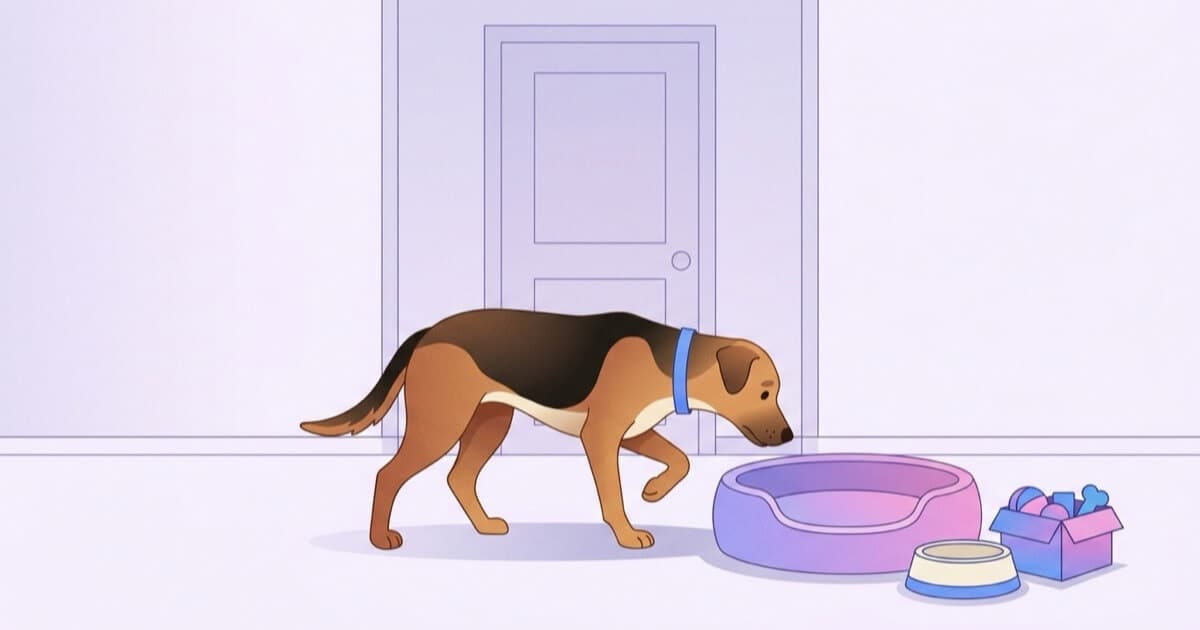
In your rescue dog's first week alone, your job is to avoid teaching it that being alone is frightening. Teaching it to be alone comes later. Mixing up those two goals is how a manageable first two weeks turns into a six-month training project. The hours you are out matter as much as the ones you are home, so it helps to know how to cover absences without leaving your dog over threshold.
Key Takeaways
- Measure your dog's first absence in seconds, no matter how calm it seems.
- The Humane Society of North Texas describes the first three days as decompression, when the dog is still getting used to unfamiliar surroundings (Humane Society of North Texas).
- A common week-one mistake is spending several days never leaving the dog's side and then going back to work on Monday.
- Film the first absence. It costs nothing and it is the only way to know what actually happened.
- Act on real distress in week one. Absences that are too long provoke anxiety and can make the problem worse.
Why week one weighs more than any week after it
A dog that has just changed homes has no basis for predicting what happens next. It does not yet know that your keys mean you come back in an hour, that the front door is not a permanent exit, or that this sofa is available tomorrow. Everything is a first sample.
This is why week one matters disproportionately. Whatever pattern the first few absences establish becomes the expectation, and expectations are much cheaper to build than to rebuild. A dog whose first ten departures were unremarkable non-events has learned something useful. A dog whose first departure was eight hours alone in an unfamiliar apartment has also learned something, and you will be working against it for a while.
None of this requires that your dog arrives anxious. Plenty do not. Week one is when the cost of a mistake is highest and the cost of doing it properly is lowest.
The decompression window
Rescue and shelter organizations commonly describe adjustment in three stages, often called the 3-3-3 rule: roughly three days to decompress, three weeks to start learning the household routine, and three months to properly settle (Humane Society of North Texas). It is a rule of thumb, and some dogs need longer, depending on their background, age and previous experiences.
The dog you meet in week one is not yet the dog you will live with. Behavior in the first days is shaped by an unsettled nervous system, so both directions of reading are unreliable.
A quiet dog in week one is not proof of a settled dog. Shutting down is common, and it looks like being well behaved. A dog that sleeps silently through its first absences may start reacting later, once it has relaxed enough to notice that you left.
Early distress often eases with predictability. Some of what you see is transitional.
Because you cannot tell these apart by watching from outside the door, the sensible approach in week one is the same either way. Go slow, and film it.
What to do before you leave the house for the first time
Do these on day one, before there is any question of leaving.
Set up one predictable resting place. A bed in a low-traffic spot with a view of the room. Avoid a closed room, and skip the crate unless your dog already knows and likes crates. Predictability is the thing that helps most, and one reliable place to be is the simplest version of it.
Establish a boring routine and keep it. Same walk times, same meal times, same order of events. It is dull, and it does more for the first two weeks than anything else you could buy.
Do not make comings and goings emotional. Keep farewells short and skip the ecstatic greeting for the first few minutes back. The goal is a door your dog finds completely uninteresting.
Book the vet check. Not for the anxiety, for everything. It also matters here because urinary infections and other medical problems produce indoor accidents that get misread as distress (ASPCA).
Set up a camera before your first absence. A phone propped on a shelf is enough. Our guide to setting up a home camera and what to watch for covers the rest.
Sort out cover for the working week now. This is the part people postpone and then get caught by. If you go back to work on day four, decide today who covers those hours: a sitter, a daycare, a neighbor, a rearranged schedule, a few days of leave. Deciding it in advance is the difference between a controlled first week and an accidental eight-hour absence.
Your first absence: start with thirty seconds
Treat the first absence as a test.
- Give your dog something to eat. A stuffed Kong or a lick mat, in view of the camera. Whether it gets eaten is your best single piece of information.
- Leave in your normal way. Keys, shoes, coat, door. Do not tiptoe.
- Close the door and stand outside for thirty seconds.
- Come back in calmly. No greeting ceremony. Walk in, put the keys down, carry on.
- Watch the footage before you do anything else.
If those thirty seconds were uneventful and the food was touched, repeat a few times across the day and extend gradually: a minute, two minutes, five. If they were not uneventful, you have learned the most useful thing available in week one, which is that your dog's starting point is below thirty seconds. That is a normal, workable starting point. The camera guide also explains how to read the footage and turn it into a threshold number.
One rule from the standard separation anxiety protocol is worth borrowing from day one: outside of these deliberate short sessions, your dog should not be left alone for longer than it can currently handle (ASPCA). That is what the cover arrangements are for.
Five common mistakes in week one
1. A full working day in the first few days
The single most costly one. It happens for entirely reasonable logistical reasons, which is why it needs a plan made in advance. If it is genuinely unavoidable, get cover for as much of it as you can, film it, and treat whatever you see as your starting point.
2. Never leaving the dog's side, then leaving for eight hours
The well-intentioned version of the same mistake. Adoption weekends often mean two or three days of constant company, which teaches the dog that you are always present, followed by a Monday that contradicts it completely. Better to build a few brief, boring absences into those first days precisely because you are around to keep them short.
3. Shutting the dog in a crate it does not know
A crate is a useful tool for a dog with positive crate history. For a dog without it, a closed crate during distress removes the option to move, which can make a panicking dog's distress worse. The ASPCA's guidance is to watch for heavy panting, drooling and frantic escape attempts, and to use a gated room instead if you see them (ASPCA).
A gate is confinement too, and a dog fighting any confinement is still in distress. Film your dog behind the gate while you are home first, and test whether a crate or gate suits your dog before relying on either.
4. Treating howling as "getting used to it"
Sometimes a short protest does fade. Genuine distress gets stronger with repetition, and every unattended episode is a rehearsal. The ASPCA warns that absences longer than the dog can handle provoke anxiety and make the problem worse (ASPCA). AVSAB's position is that easing fear depends on building positive associations with what frightens the dog, and that aversive methods have no role in behavior modification (AVSAB, 2021).
5. Not filming the first absence
You cannot get week one back. Thirty seconds of footage from day two is worth more than a month of speculation, and it is the only version of your dog's starting point you will ever be able to compare against. Set the camera up first.
Telling "settling in" from a real problem
Both look like a dog that is unhappy when you leave. The distinction is in the pattern, and it is visible on the recording.
| Settling in | More likely a real problem |
|---|---|
| Reacts for a minute or two, then genuinely sleeps | Reaction escalates or comes in waves across the absence |
| Eats what you left | Will not touch food it would eat in front of you |
| Restlessness spread around the apartment | Behavior concentrated at the exit: scratching, digging, chewing the frame |
| Improves noticeably across the first ten days | No change or worse across two weeks of short, controlled absences |
| Accidents that reduce as routine establishes | Accidents only when alone, never when you are home |
Two of these deserve emphasis because they carry the most weight. Food refusal while alone, from a dog that eats when you are home, is one of the clearest signs it is over its threshold. The ASPCA notes that highly anxious dogs usually won't eat when their guardians are gone (ASPCA). Damage located at the exit distinguishes an attempt to escape from ordinary destructiveness, which happens wherever the interesting object is.
If the pattern points to a real problem, that is common and workable. It means you start the graduated protocol at a low number now. To narrow down the cause, compare the six possible reasons a dog barks when you leave, then read the complete guide to dog separation anxiety.
Puppies also cry for reasons that have nothing to do with separation, such as a full bladder or teething. If your new dog is a puppy, read how to tell normal puppy crying from separation anxiety.
What week two should look like
Week two is where the actual training starts, and it is deliberately unexciting.
- You have a threshold number from the footage.
- You run short, repeated absences below that number, several a day.
- You work on departure cues before time away: pick up the keys ten times without leaving, or put on your shoes and sit back down.
- You add seconds only after several calm repetitions.
- Log every session so you can see the trend.
- Cover continues for the hours you cannot yet do.
The protocol is the same regardless of how your dog came to you. Read the graduated plan for building up time alone before week two starts.
One expectation to set now: progress is not linear, and the third week of training often looks worse than the second. That dip is normal in a graduated protocol and does not mean it is failing. The realistic timeline for separation anxiety training shows what that dip looks like.
When to get help early
Ask for professional help in week one or two if you see any of these.
- Your dog injures itself: bleeding paws, damaged nails, broken teeth from chewing at the exit.
- Your dog escapes or nearly does.
- Food goes untouched for a day or more.
- You cannot arrange any cover, so your dog is regularly alone well above its threshold.
- Two weeks of controlled short absences have produced no change at all.
Start with your vet, because medical causes have to be ruled out and a vet can refer you on. AVSAB publishes guidance on choosing a trainer and what credentials mean (AVSAB, 2026), and if you want to know what the various routes cost before you make calls, we have published the actual figures.
FAQ
How long can I leave my new rescue dog alone in the first week? Start at thirty seconds and let the footage tell you. There is no age-based or breed-based answer that beats measuring your own dog, and in week one the honest default is "less than you think".
Should I get a second dog so mine is not lonely? Not as a solution to this. Distress at being left is usually about separation from the person the dog is attached to (ASPCA), so a second dog often means two dogs and the same problem. It is also a poor time to add a variable, since your first dog has not finished settling.
My rescue was fine for the first three days and is now worse. Did I do something wrong? Probably not. Shutting down in the first days is common, and the change may simply mean the dog has relaxed enough to react. Treat the current behavior as your real starting point and begin from there.
Is a crate a good idea for a rescue dog's first absences? Only if the dog already has positive crate history. Otherwise use a gated room, tested on video while you are home, since a gate is still confinement. Watch for panting, drooling and frantic escape attempts, and stop if you see them (ASPCA).
Should I leave the radio or TV on? Harmless, and worth trying. It can mask corridor noise for dogs that react to outside triggers. It will not change the behavior of a dog that is panicking about your absence, so do not read a lack of effect as a bad sign. Your neighbors still hear the barking. If you live in an apartment, read how to handle neighbors and landlords in an apartment.
How do I know if this is separation anxiety or just adjustment? The recording answers it faster than time will. Look at whether the food gets eaten, where any damage is located, and whether the reaction escalates or settles. The six causes of barking when you leave cover the full differential.
Last updated: