
Dog Separation Anxiety in an Apartment: Neighbors and Noise
Lopaw · · 13 min read
Training a dog with separation anxiety in an apartment? How to log the barking, tell neighbors early, what soundproofing can't fix, and how noise rules work.
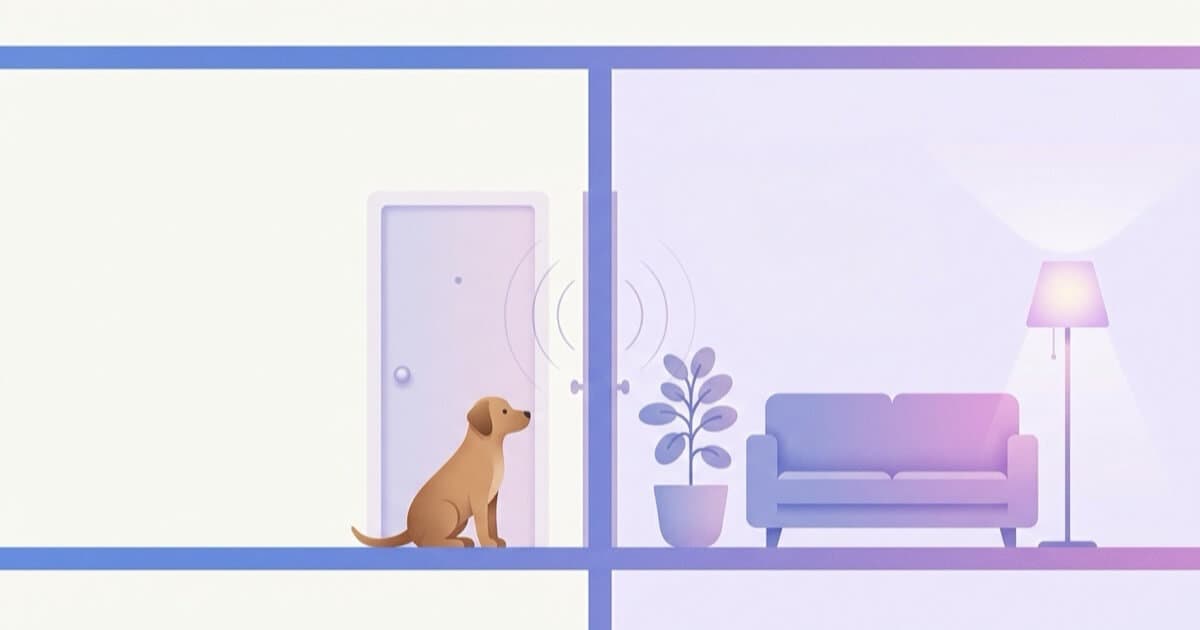
Dog separation anxiety in an apartment is the same problem as anywhere else, with an audience. Your neighbors hear it first, and a complaint can start a formal process. The fix is still training, and the biggest single step is never leaving your dog alone longer than it can cope with. While you train, log what the neighbors hear, talk to them early and skip the fixes that backfire. For the signs and causes, start with the main guide to dog separation anxiety.
This is general information, not legal advice. Rules vary by country, city and tenancy.
Key Takeaways
- Neighbors often hear separation anxiety before you see it. Dogs that vocalize when left alone "are likely to prompt complaints by neighbors and visits from local authorities" (Sargisson 2014).
- The fastest fix for the noise is the fix for the anxiety: don't leave your dog alone longer than it can cope with.
- Log time of day, how long the barking lasts and how often it happens. New York City's DEP may act on barking heard from a home for 10 minutes straight by day or 5 at night (NYC311).
- A tenant can do little to soundproof an apartment, because sound also travels through floors, ceilings and side walls (NRC Canada).
- In New York City, Los Angeles and English councils, the complaint process usually starts with a letter to the owner.
- Don't use a bark collar. AVSAB says aversive methods "should not be used in canine training or for the treatment of behavioral disorders."
Why an apartment makes separation anxiety harder
An apartment changes how the problem is found and what is at stake. You are out when it happens, so the first sign often comes through the wall.
A 2014 review notes that diagnosis "generally relies on indirect evidence, such as evidence of destruction or reports of barking by neighbors, because the problem behaviors occur primarily in the absence of the owner" (Sargisson, 2014).
In one clinic study of 78 separation anxiety cases seen at Cornell between 1993 and 1997, a higher share of these dogs "tended to live in apartments" than dogs seen for aggression (Takeuchi et al., 2001). That is a pattern in clinic caseloads, not proof that apartments cause the problem.
Lund and Jørgensen filmed 20 dogs with separation problems, most of them loose in their owners' apartments. They concluded the problems come from frustration related to dependency on the owner, not disobedience or boredom (Lund and Jørgensen, 1999). Because the cause is distress at being alone, the quickest way to quiet the apartment is to arrange cover (someone with your dog) while you train.
Find out what your neighbors actually hear
Before you buy anything or apologize to anyone, record one absence (how to set up the camera). You want three facts: when the noise starts, how long it lasts, and what time of day it happens. Neighbors hear only the loud part. Of the 20 dogs in Lund and Jørgensen's study, 19 whined, 17 barked and 14 howled. The authors link barking to arousal and suggest howling and whining may reflect fear. The camera also shows the pacing and quiet whining nobody next door hears, and why barking can come back in waves during a long absence.
Not every bark is separation anxiety. In a building with a shared hallway, some dogs bark at the elevator, footsteps or deliveries. Barking at corridor noise is a different problem with a different fix.
Then keep a simple log:
| Date | Out / back | Minutes until first noise | Longest continuous stretch | Day or night |
|---|---|---|---|---|
| Example: Mon | 8:10 / 8:40 | 4 | 6 min | Day |
| Example: Tue | 19:00 / 19:20 | 2 | 11 min | Day |
These columns match what complaint processes look at. New York City counts continuous minutes and time of day. Los Angeles weighs frequency, volume and "the time of day or night". One English council asks whether noise is "occurring on a frequent basis" (Rushcliffe Borough Council). Log the same numbers and you see the problem as the council would. You can also show progress.
Film only inside your own home. Wrexham council tells people recording noise to "avoid video recording persons as this could be classed as surveillance" (Wrexham County Borough Council).
Tell your neighbors before they tell someone else
A short word before anyone complains usually goes further than an apology after.
Rushcliffe Borough Council advises people bothered by a barking dog to "try approaching the owners of the dog(s). If they are out at work when the dog is barking, they may not be aware of the problem". Neighbors who know have a reason to come to you first.
Keep it to a few points:
- your dog gets anxious when left alone, and you are training it
- you are arranging things so it is not left longer than it can manage
- ask them to tell you when they hear it and at what time, and give them your number
If they are interested, share your log.
Soundproofing: what a tenant can and can't change
How much sound passes between apartments depends on the whole building, so a tenant can change little. Treat soundproofing as an extra on top of training.
Canada's National Research Council explains why. "Flanking transmission" is "structure-borne sound transmission that bypasses the separating wall and travels through other building elements such as the floor, ceiling, or walls". In the authors' words, "it is the performance of the whole system and not just that of the separating assembly that will determine the sound insulation experienced by occupants" (Quirt and Nightingale, NRC, 2008). That work looked at North American wood-frame buildings.
What you can do:
- Move your dog's resting spot away from the shared wall and the front door, which also means fewer corridor triggers.
- Close your own internal doors if your dog stays relaxed with them shut. Check on video first. Do not shut a dog in a small room to muffle it, because confinement can backfire.
- Don't count on rugs, curtains or renter soundproofing products to make the apartment quieter next door. NRC's work suggests the building sets most of how much gets through.
A radio or TV, which Dogs Trust suggests when you must leave your dog, may mask corridor sounds for your dog. It does nothing for the neighbors.
What the rules say about barking
In England and in US cities such as New York and Los Angeles, a barking dog can become a legal problem, and the process usually starts with a letter.
England. Under the Environmental Protection Act 1990, "noise emitted from premises so as to be prejudicial to health or a nuisance" is a statutory nuisance (s.79). Government guidance says the noise must "unreasonably and substantially interfere with the use or enjoyment of a home" or harm health, and names "barking dogs" as an example.
If the council agrees, it "must serve an abatement notice". It can delay the notice by up to 7 days while it tries to get the noise stopped (gov.uk). You can appeal "within 21 days". Ignoring the notice can mean prosecution and a fine "set by the court" (gov.uk).
United States. There is no single US rule. Two city examples:
- New York City. DEP "may take enforcement action if the noise can easily be heard from a residential address" for 10 minutes straight between 7am and 10pm, or 5 minutes straight between 10pm and 7am (NYC311). "First complaints of excessive animal noise may lead to education" (NYC DEP).
- Los Angeles. No minute count. The Department weighs "the nature, frequency and volume of the noise", "the time of day or night" and "the number of neighbors affected by or complaining about the noise". Complaints must be in writing (LA Animal Services).
| Step | England (council) | New York City | Los Angeles |
|---|---|---|---|
| First contact | Letter to the owner. Complainant gets a diary sheet or app (varies by council) | DEP letter to the owner within 10 days | Written notice to the owner |
| Evidence | Complainant's diary or recordings, then officer observation | Inspection if DEP has already written | Second complaint after 15 days, usually with one from another household |
| Formal step | Abatement notice (may be delayed up to 7 days) | Summons if DEP witnesses a violation | Meeting with a Department representative |
| After that | Appeal within 21 days. Fine set by the court if not complied with | Enforcement under the Noise Code | Hearing if the problem stays unresolved |
Check your own council or city website. Scotland, Northern Ireland and other countries are not covered here.
Your tenancy and your landlord
Permission to keep a dog does not protect you from noise rules.
Private renters in England. From 1 May 2026, you can ask your landlord in writing for consent to keep a pet. Consent "is not to be unreasonably refused", and the landlord must answer in writing, normally within 28 days (longer if it asks for more information or needs a superior landlord's consent). Social housing is excluded (Renters' Rights Act 2025, s.11).
Refusal can be reasonable if the pet would breach your landlord's own lease with a superior landlord, for example in a block of flats, and government guidance says "you can challenge the landlord's decision in court" (gov.uk).
Noise is separate. Ground 14 of the Housing Act 1988 lets a landlord seek possession if a tenant "has been guilty of conduct causing or likely to cause a nuisance or annoyance" to people in the locality (Sch. 2). A court decides whether possession is reasonable, and in England since 1 May 2026 it must consider "whether the person against whom the order is sought has co-operated with any attempt by the landlord to encourage the conduct to cease" (s.9A).
In the US, your lease and local law set the terms. In California, for example, a landlord can serve a 3-Day Notice to Perform Covenants or Quit when a tenant breaks the lease in a fixable way, "for example, remove a pet, stop noise, or follow other lease rules". The tenant must fix the problem or move out, and Saturdays, Sundays and court holidays don't count toward the 3 days (California Courts). Reread the pet and nuisance clauses, and tell your building manager early that you are working on the problem.
Either way, keep it written: your log, your training plan, your cover. If a possession or eviction notice arrives, get legal advice: Shelter or Citizens Advice in the UK, a local tenant rights organization in the US.
Why a bark collar makes things worse
A collar can silence the barking while the panic continues. You also lose the signal that shows progress.
AVSAB, the American Veterinary Society of Animal Behavior, says aversive methods "should not be used in canine training or for the treatment of behavioral disorders". Its list of tools to avoid includes "electronic shock collars" and "compressed air cans" (AVSAB, 2021).
The Merck Veterinary Manual adds: "Positive punishment should be avoided, because it can cause fear and anxiety toward the owner or fear of the situation and surrounding triggers." The RSPCA warns that "separation-related behaviour problems get worse when owners punish their dogs on their return."
In Wales, attaching "a collar designed to administer an electric shock" to a dog has been banned since 24 March 2010 (SI 2010/943). In England, regulations for a ban were laid before Parliament in 2023 but not approved by the Commons (BVA). The government said in December 2025: "We will gather views and evidence on the current use of e-collars to inform whether to take forward a ban" (Animal Welfare Strategy). The Welsh ban covers shock collars only, not citronella or ultrasonic ones, but AVSAB's position covers aversive tools in general.
To lower the panic itself, follow the graduated desensitization protocol.
Your apartment checklist
- Film one absence and start the log.
- Stop leaving your dog alone longer than its threshold, and line up cover for the rest.
- Tell your nearest neighbors, briefly, before anyone complains.
- Move your dog's resting spot away from the shared wall and the front door.
- Skip the bark collar.
- Check your tenancy's pet and noise terms. Renting privately in England? Ask for pet consent in writing.
- If a council or city letter arrives, reply with your log and plan, and get advice if it escalates.
Lopaw is an app, on the App Store and Google Play, that tracks your dog's threshold and logs each training session, so you know which absences are safe and can show the numbers moving.
FAQ
Can I be evicted because my dog barks when I'm out? Possibly, if the noise amounts to a nuisance. Under a US lease, the outcome depends on the lease terms and local law. In England it means a court case under Ground 14, where the court weighs reasonableness and whether you co-operated with your landlord.
How much barking counts as a noise nuisance? There is no universal number. New York City uses 10 continuous minutes by day and 5 at night. Los Angeles and English councils weigh factors such as frequency, volume, time of day and the effect on the home next door.
Does soundproofing work for a barking dog? Only within limits set by the building, because sound also travels through floors, ceilings and side walls (NRC Canada).
Will a bark collar or citronella collar stop it? It may mute the noise while the anxiety stays. AVSAB advises against aversive tools, including shock collars and compressed air, and a citronella collar works by spraying the dog when it barks, much like the squirt bottles on AVSAB's list. Shock collars are banned in Wales but not in England.