
Crate Training a Dog with Separation Anxiety: Help or Harm?
Lopaw · · 13 min read
Crating a dog with separation anxiety can help or harm. How to tell confinement anxiety from separation anxiety, and how a crate, gate and free roam compare.
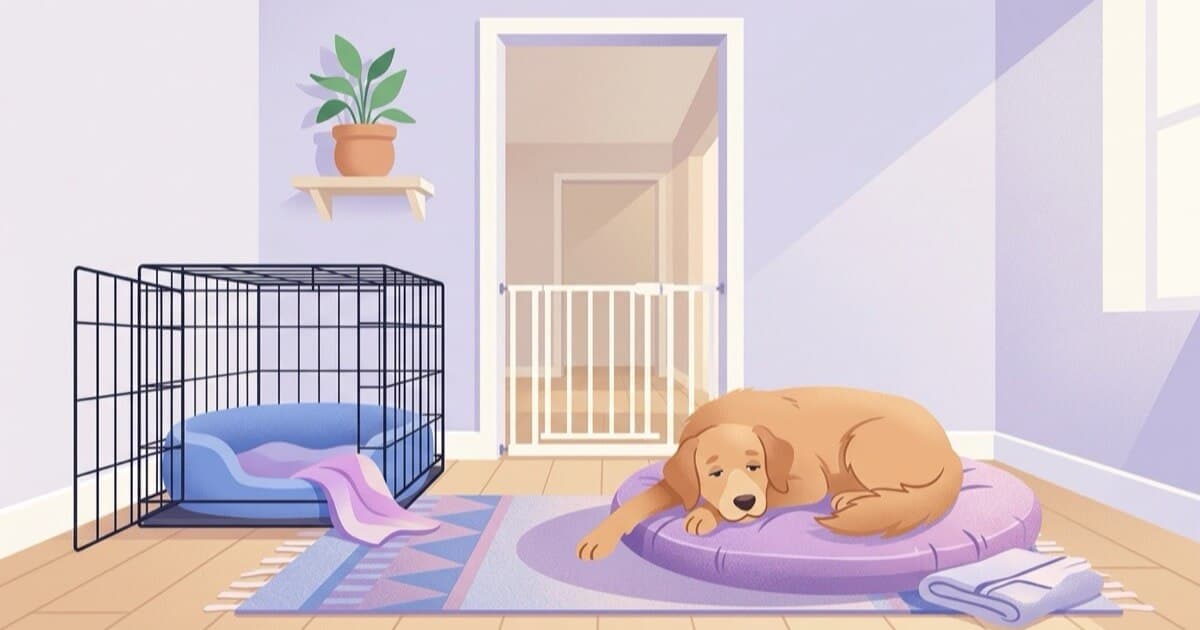
A crate can help a dog with separation anxiety only if the dog already treats it as a safe den and can leave it. For many dogs a closed crate adds a second fear on top of the first. And a crate never treats separation anxiety itself: the training that actually treats it is graduated desensitization, whatever space your dog is in.
Key Takeaways
- A crate does not treat separation anxiety. As Dogs Trust puts it, "Crate training alone won't stop your dog worrying about being left."
- A 2014 review cites a study finding that crated dogs were "no less likely" to show separation problems than dogs with the run of the home (Sargisson 2014).
- In a 2024 survey of 1305 owners, distress signs rose significantly when a crate was used to manage behavior problems (Bleuer-Elsner and Masson 2024).
- Confinement anxiety and separation anxiety are different problems that can occur together. Two short videos tell them apart.
- Keep the crate door open so the dog chooses to be there, and test a gated room the same way.
- For absences longer than your dog can cope with, arrange cover. A different room does not help.
The short answer: a crate manages but does not treat
A crate can limit damage to your home. Dogs Trust says, "The only way to stop separation anxiety is to change how your dog feels about being left" (Dogs Trust). Humane World for Animals (formerly the Humane Society of the United States) says, "Attempting to use the crate as a remedy for separation anxiety won't solve the problem" (Humane World for Animals). The RSPCA goes further and says a crate "must never be used as a punishment or to prevent unwanted behaviours such as destruction of furniture" (RSPCA).
The ASPCA takes the middle line. It says crating can be "helpful for some dogs if they learn that the crate is their safe place", while for others "the crate can cause added stress and anxiety" (ASPCA). This page is about adult dogs and daytime absences. For puppies and night-time crating, see the puppy guide.
What the evidence says about crates and separation anxiety
There is little research, none of it shows that a crate reduces separation anxiety, and some findings point to harm when the door is closed.
The 2014 review. A review of treatment options notes that some authors recommended crating because crate-trained dogs "rarely engage in the stress-related behaviors" seen in dogs with free access. But the review cites a study finding that "dogs left in crates or cages while at home alone are no less likely to display separation-related problem behaviors than dogs that have free access to the home." It adds that crating a dog with separation anxiety "can increase lip licking", "a response consistent with stress" (Sargisson 2014).
An owner survey on crates. A 2024 survey of 1305 dog owners in 23 countries found that 332 (25.4%) currently use or have used a crate (the paper says "cage") for training or behavioral purposes, mostly with puppies aged six months or younger. Overall, owners reported little discomfort, but signs of distress rose significantly when the crate was used to manage a behavior problem. The authors conclude that crating is "ineffective and potentially detrimental when used for behavioral therapy in dogs with behavioral disorders." They add that using a crate "as a personal and protected space can be beneficial if the dog retains control over its use" (Bleuer-Elsner and Masson 2024). Owners were self-selected through the first author's network, and every answer is an owner report, so treat it as a signal.
Chewing at the bars. In a University of Lincoln survey run during the COVID-19 lockdown, owners recalled how their dogs behaved when crated or gated before lockdown. Dogs that had chewed the bars or tried to escape were more likely to show three of four separation-related problems when their owner left the room during lockdown. They suggest "poor frustration tolerance" could explain all of these (Sherwell et al. 2023). The study did not test whether crates cause harm. Treat it as a warning sign worth filming. It is not proof.
Injuries. The ASPCA warns that escape attempts "could result in self-injury, such as broken teeth, cut and scraped front paws and damaged nails." Dogs Trust and Humane World give the same warning. VCA's veterinary behaviorists, Debra Horwitz and Gary Landsberg, write that "crates should be used with caution because they can promote intense escape attempts and may result in fairly serious injuries" (VCA). Sargisson's review notes the same risk. We found no study that counts how often it happens.
Two problems that look the same: confinement anxiety and separation anxiety
A dog can be afraid of being shut in, afraid of being alone, or both. Each is handled differently.
The Merck Veterinary Manual lists confinement anxiety among the conditions to rule out before diagnosing separation distress. It also notes that destruction can happen "because of fear or anxiety (eg, due to confinement or noise phobias)" (Borns-Weil, Merck Veterinary Manual). According to VCA, destruction or house soiling "when a dog is locked up in a crate, basement, or laundry room, may be due to confinement or barrier anxiety and associated attempts at escape." Such dogs "should be assessed to see if they act in the same way when they are confined while the owner is at home." A 2018 review agrees that "Separation anxiety, noise aversions, and confinement distress may be comorbid" and that "A behavioral history and video can help confirm the diagnosis" (Ballantyne 2018, abstract).
A published case shows why this matters. A puppy started crate training at eight weeks and vocalized for at least an hour every time she was crated, "even with the clients present". When the crate was replaced with an exercise pen, she "escaped from the pen". She then scratched and chewed walls and a door frame. The veterinary behaviorists concluded she had both conditions: "Confinement anxiety can be misdiagnosed as separation anxiety if the dog is only confined when home alone" (Heinrich and Calder 2024).
Researchers analyzing 762 dogs with separation-related problems proposed a profile they called "exit frustration": dogs that try to follow the owner but are "unable to do so due to barriers within the home" (de Assis et al. 2020). Confinement is not a precondition either. In a video study of 20 dogs with separation problems, most ran freely in the apartment. Only three were shut in part of it (Lund and Jørgensen 1999).
Dogs Trust adds that a dog confined to a crate, one room or part of the house "may be struggling with the lack of choice rather than being left alone."
The test: which problem does your dog have?
Two short video checks answer the question better than guessing. The camera guide explains how to set up the camera and read the footage.
Check A: closed in, you at home. The ASPCA advises you to "monitor your dog's behavior during crate training and when he's left in the crate while you're home." Look for "heavy panting, excessive salivation, frantic escape attempts, persistent howling or barking". The RSPCA adds "cowering or aggression". Dogs Trust mentions "whining or scrabbling to get out" (Dogs Trust). Use the same check for a gated room or pen, and stop at the first sign of panic. Do not wait it out.
Check B: alone, door open. Leave for a short absence, below what you think your dog's threshold is, with your dog loose in a safe area. Signs tend to show early. In a video study of 23 dogs seen at two behavior clinics, most showed signs within 10 minutes of the owner leaving, and vocalizing began after 3.25 minutes on average (Palestrini et al. 2010). The sample was small and not representative.
Check A: distress when closed in, you at home. Check B: distress when alone, door open.
A yes · B no
Confinement anxiety
Stop closing the door. Drop the crate for now.
A yes · B yes
Both
No confinement for now. Get professional help.
A no · B no
Probably fine
A crate or gate is probably fine. Still keep every absence under threshold.
A no · B yes
Separation anxiety
The space is not the problem. Train, and cover absences your dog cannot yet handle.
If your dog is a recent adoption, you probably do not know its crate history. Dogs Trust notes that "Some rescue dogs might have good, or bad, experiences of being in a crate", so run both checks. The guide to a rescue dog's first week covers the rest of that period.
How a crate, gate, pen and free roam compare
The best option is the one where your dog is calm on video, can move away from the door, and is never left alone for longer than its threshold. What matters most is whether your dog keeps some control over where it is.
| Option | Can suit | Main risk | Test before use | Source |
|---|---|---|---|---|
| Closed crate | A dog with a positive crate history, calm in it on video both with you home and alone | Panic, escape attempts and injury. Adds confinement stress | Checks A and B | ASPCA, Dogs Trust, VCA, Sargisson 2014 |
| Open crate as a den, door fixed open | A dog that already chooses the crate to rest | Low. A loose door can swing shut, so fix it open | Your dog goes in on its own | Dogs Trust, RSPCA, Bleuer-Elsner and Masson 2024, Humane World |
| Gated room or pen | A dog that paces or damages the home but is calm behind a gate with you home | The same "lack of choice". Some dogs climb or escape | Same as a closed crate | ASPCA, Dogs Trust, Heinrich and Calder 2024 |
| Free run of the home | A dog that is calm alone and not destructive | Chewing, damage at exits, access to hazards | Film one short absence | ASPCA, Merck |
| Not alone (cover) | Any dog, whenever an absence is longer than its threshold | Cost and logistics | None needed | Merck, ASPCA |
The first four rows only apply to absences shorter than your dog's threshold. For everything longer, use the last row: cover for the absences your dog cannot yet handle.
Setting up the alternative
If the crate does not suit your dog, use a room or area it already likes.
- Pick a place your dog already chooses to rest. Dogs Trust suggests you "consider if they're somewhere they'd normally choose to spend time."
- Not a room your dog only goes into when shut in, such as a basement or laundry room. VCA advises an area that "does not further increase your dog's anxiety", adding that "Your dog's bedroom or feeding area may therefore be most practical."
- Bed, water, and a long-lasting chew or food toy (RSPCA, Dogs Trust).
- A baby gate or pen that lets your dog see and hear the home. Dogs Trust advises, "Make sure the pen is tall enough and secured."
- Build it up while you are at home, in short steps (Humane World, RSPCA).
- Run check A on video before the first real absence.
- Keep every absence under threshold.
Never use the room, the gate or the crate as a punishment (RSPCA, Humane World). If the plan is to keep the dog quiet for the neighbors, a crate will not quiet a dog that panics in it (see the distress signs in check A). The apartment guide explains why confinement can backfire.
If your dog already loves its crate
Humane World says, "The crate should always have a comfortable bed and the door left open when you're home so your dog can enter it when they need a safe space." It also advises crating for short periods while you are home, "so they don't associate crating with being left alone." Dogs Trust says that if a safe space is part of the plan your behaviorist puts together, "a crate could possibly be used as a safe space", and "The door should always be fixed open". The Merck manual describes a "safe haven" for noise phobias, built "long before using it".
Keep it as a resting place. If you close the door during absences, do it only after both checks, and only for short ones. General crate guidelines from the RSPCA and Humane World run to a few hours, and they are not written for dogs with separation anxiety. For your dog, the limit is its threshold.
Lopaw is an app that helps you find that threshold and logs each training session, crate or no crate. It is on the App Store and Google Play.
FAQ
Should I crate my dog if it has separation anxiety? Only if your dog is already calm in the crate, both with you at home and alone. A crate does not treat separation anxiety, and for some dogs it adds a second fear.
Is it separation anxiety or crate anxiety? Distress only behind a closed door points to confinement. Distress in any space without you points to separation anxiety. A dog can have both (Heinrich and Calder 2024, Merck).
Is a baby gate better than a crate for separation anxiety? The ASPCA suggests "one room behind a baby gate" for a dog that struggles in a crate. But a gate is still confinement, and the puppy in the published case escaped from a pen too. Test it the same way.
Can a dog hurt itself trying to get out of a crate? Yes. The ASPCA, Dogs Trust, Humane World and VCA all warn about injuries from escape attempts. If your footage shows escape attempts, stop crating.